

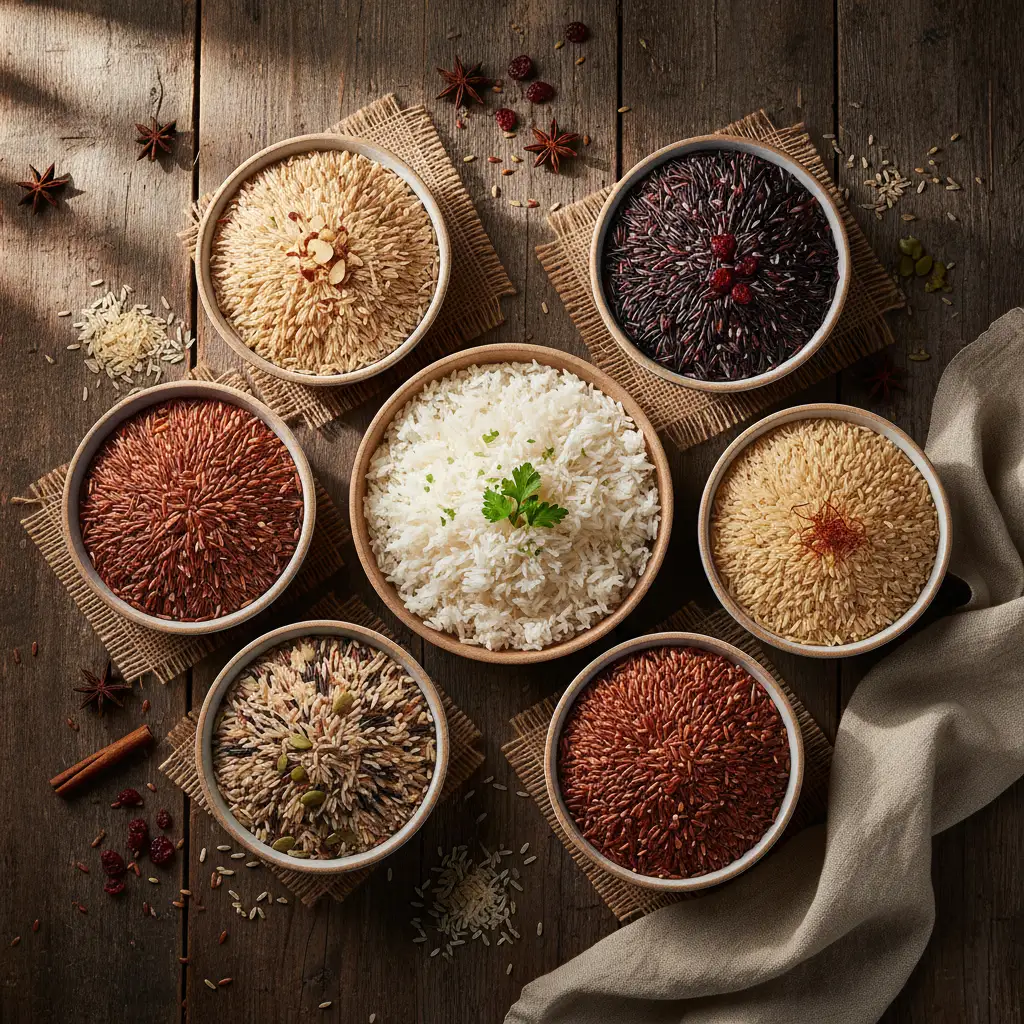
Quick answer: cooked white rice has about 130 calories per 100 grams, or roughly 205 calories per cup (158 g). Brown rice is similar — around 112–123 calories per 100 g depending on the variety. The type of rice matters less than most people think; the portion size and what you cook it with matter far more.
Here is the full breakdown, with numbers from USDA FoodData Central.
Calories by Rice Type (per 100 g, cooked)
| Rice Type | Calories | Protein | Carbs | Fat |
|---|---|---|---|---|
| White rice, long-grain | 130 | 2.7 g | 28 g | 0.3 g |
| Brown rice, medium-grain | 112 | 2.3 g | 24 g | 0.8 g |
| Brown rice, long-grain | 123 | 2.7 g | 26 g | 1.0 g |
| Basmati* | ~121 | 3.5 g | 25 g | 0.4 g |
| Jasmine* | ~129 | 2.7 g | 28 g | 0.2 g |
| Wild rice | 101 | 4.0 g | 21 g | 0.3 g |
White and brown rice values are from USDA FoodData Central. *Basmati and jasmine are typical values from manufacturer data — USDA does not track them as separate entries, and in practice they land within a few calories of regular long-grain white rice.
Two things stand out in this table. First, brown rice is not a low-calorie alternative — it saves you a handful of calories at best. Its real advantages are fiber (about 1.8 g per 100 g vs 0.4 g in white) and a bit more magnesium and B vitamins. Second, wild rice — technically a grass seed, not rice — is the lightest option and carries the most protein.
Cooked vs Dry: The Mistake That Triples Your Numbers
This is the single most common rice-logging error. Dry rice has about 360–370 calories per 100 g. Cooked rice has about 130. Rice roughly triples in weight as it absorbs water, so the same calories spread across three times the mass.
What that means in practice:
- If you weigh rice before cooking: 100 g dry ≈ 360 kcal — and it will cook up into a large bowl
- If you weigh rice after cooking: 100 g cooked ≈ 130 kcal — a modest side portion
- A typical restaurant side of rice (200–250 g cooked) is 260–330 kcal
Log the state you actually measured. A food diary that mixes dry and cooked weights can be off by a factor of three — enough to erase a whole week’s calorie deficit on paper.
Common Serving Sizes
| Serving | Weight | Calories (white rice) |
|---|---|---|
| 1 tablespoon | ~12 g | ~16 |
| Half cup | 79 g | ~103 |
| 1 cup | 158 g | ~205 |
| Small side bowl | 150 g | ~195 |
| Restaurant portion | 250 g | ~325 |
| Sushi roll (8 pieces, rice share) | ~120 g | ~155 |
Does Cooking Method Change the Calories?
Somewhat — but mostly through what you add, not how you heat it:
- Boiled or steamed — the baseline. Steaming and boiling produce essentially the same result; boiling in excess water and draining can wash out a small amount of starch.
- Fried rice — this is where numbers explode. A tablespoon of oil adds ~120 kcal, and restaurant fried rice often contains two or more, plus egg. A cup of fried rice typically runs 330–360 kcal against ~205 for plain.
- Rice cooked in broth or with butter — count the additions. A teaspoon of butter is ~34 kcal; coconut milk in one cup of coconut rice can add 100+ kcal.
The Cooling Trick: Real, But Modest
You may have seen claims that cooling rice “removes calories.” The mechanism is real: when cooked rice cools, part of its starch converts to resistant starch, which your gut ferments instead of digesting. A 2015 study in the Asia Pacific Journal of Clinical Nutrition found that white rice cooled for 24 hours and then reheated had significantly more resistant starch and produced a lower glycemic response than freshly cooked rice.
The honest caveat: the measurable effect on absorbed calories is modest — think a few percent, not a diet strategy. Cooled-and-reheated rice is a nice bonus if you meal-prep anyway; it will not offset an oversized portion.
Rice and Weight Loss: Should You Drop It?
No — you should measure it. Rice is calorie-dense but not uniquely fattening; a cup of cooked rice has fewer calories than a cup of cooked pasta (~220) and about the same as a large bagel. The problems are portion creep (rice is easy to heap) and calorie-dense partners: oils, fatty meats, sweet sauces.
What works in practice:
- Weigh or eyeball consistently. One level cup, not a mound. If you don’t want to weigh every serving, weigh it for a week — your eye calibrates quickly.
- Prefer intact grains when you can. Brown and wild rice digest more slowly and keep you full longer — the fiber, not the calorie count, is the win.
- Fill half the plate with vegetables. Volume without density is the oldest trick in weight management because it works.
- Watch the sauce, not just the rice. Teriyaki, curry with coconut cream, and butter-finished pilaf routinely add more calories than the rice underneath.
Track It Without the Math
Weighing rice, checking whether the database entry means dry or cooked, converting cups to grams — this is exactly the friction that makes people quit tracking. ScanFood.AI removes it: send a photo of your plate to the bot in Telegram, and the AI estimates the rice type, portion size, and full calorie and macro breakdown in seconds. You can adjust the portion if the estimate looks off, and every meal is saved to your diary automatically. Try it with our photo calorie counter, or calculate a whole dish with the recipe calorie calculator.
FAQ
How many calories are in a cup of cooked white rice? About 205 calories per cup (158 g), based on USDA data for long-grain white rice.
Is brown rice better for weight loss than white rice? Only marginally by calories (112–123 vs 130 per 100 g). The meaningful difference is fiber and slower digestion, which help with satiety. Eat whichever you’ll enjoy in a controlled portion.
Should I weigh rice cooked or dry? Either works — but log the matching entry. 100 g dry ≈ 360 kcal; 100 g cooked ≈ 130 kcal. Mixing them up is the most common rice-tracking mistake.
Does washing rice reduce calories? Rinsing removes surface starch and improves texture, but the calorie change is negligible. It’s a cooking technique, not a nutrition hack.
Does reheating cooled rice keep the resistant starch benefit? Yes — the study cited above tested rice that was cooled for 24 hours and then reheated; the resistant starch survives reheating.
Sources
- USDA FoodData Central — Rice, white, long-grain, regular, enriched, cooked
- USDA FoodData Central — Rice, brown, medium-grain, cooked
- Sonia S. et al. Effect of cooling of cooked white rice on resistant starch content and glycemic response. Asia Pac J Clin Nutr, 2015
This article is for informational purposes. For personal dietary advice, especially if you have diabetes or another medical condition, consult your doctor or a registered dietitian.