

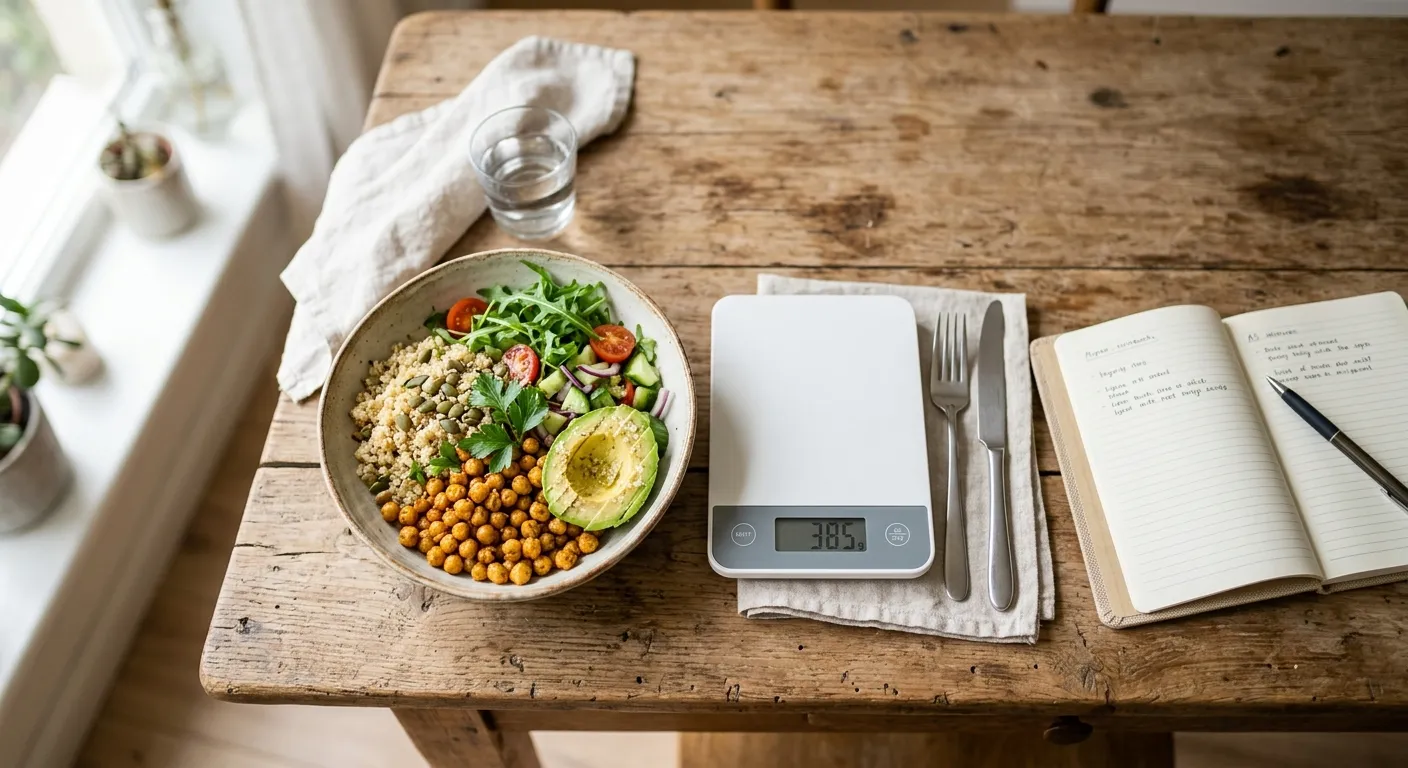
Quick answer: You do not need absolute precision to lose weight; consistent calorie tracking and an average energy deficit can support fat loss. Focus on measuring calorie-dense foods such as cooking oils and nuts, while using hand portions, standard servings, or photos for lower-calorie foods.
You do not need a food scale attached to your hip to lose body fat. Yet gym forums and fitness influencers can make it seem as though failing to weigh spinach to the nearest gram means you have failed.
Many people start a diet with good intentions, buy a digital scale, weigh every chicken breast, log every lettuce leaf, and burn out quickly. They do not quit because calorie tracking cannot work; they quit because turning every meal into a detailed accounting task can be exhausting.
Learning how to count calories without making it your second job comes down to one point: your body is an organism, not a laboratory bomb calorimeter. Drop the obsession with perfect numbers, and tracking can become a lighter habit rather than a daily chore.
The myth of 100% precision: Why your body is not a bomb calorimeter
Nutrition labels commonly use the Atwater system, an energy-estimation framework developed in the late nineteenth century. It generally assigns 4 kcal per gram of protein, 4 kcal per gram of digestible carbohydrate, 9 kcal per gram of fat, and 7 kcal per gram of alcohol.
In the United States, FDA compliance rules generally allow the measured calorie content of a packaged food to be up to 20% higher than the label declaration. A snack labeled as 200 calories could therefore test as high as 240 calories and still meet that aspect of the compliance standard. Label rules, rounding requirements, product formulation, and the nutrient involved can affect how compliance is assessed.
Your digestive system adds another layer of variation. Digestion, absorption, and metabolism require energy; this is called the thermic effect of food.
Protein generally has the highest thermic effect, often estimated at roughly 20–30% of the energy it provides. Carbohydrate is commonly estimated at about 5–10%, while fat is usually estimated at roughly 0–3%. These are broad averages, not values that can be precisely calculated for each meal.
A raw almond can provide less metabolizable energy than the standard Atwater calculation suggests because some fat remains trapped within intact plant cell walls and is not absorbed. Research by David Baer and colleagues in The American Journal of Clinical Nutrition found that the measured metabolizable energy of whole almonds was lower than the value predicted by conventional Atwater factors. The difference varies by the form of the almonds, including whether they are whole, chopped, roasted, or made into butter.
- Protein digestion: Usually has the highest thermic effect, often roughly 20–30% of ingested energy.
- Carbohydrate digestion: Commonly estimated at roughly 5–10% of ingested energy.
- Fat digestion: Usually has the lowest thermic effect, often roughly 0–3% of ingested energy.
- Fibrous plant matter: Can vary substantially because humans do not digest insoluble fiber directly, while some fermentable fibers can be metabolized by gut microbes.
Energy expenditure also changes from day to day with body size, movement, exercise, sleep, illness, stress, environmental temperature, and other factors. That does not make tracking useless; it means the goal is a useful, repeatable estimate rather than laboratory-grade precision.
What matters is a consistent baseline. If estimated intake is broadly consistent and your average body weight trends downward over several weeks, your overall energy balance is likely moving in the direction you want.
How to count calories without making it your second job: The three precision levels
You do not need the same level of accuracy for an egg and a dry ribeye steak. In practice, it can help to split foods into three precision levels.
Level 1 is for calorie-dense foods such as fats, nut butters, and rich dressings. A modest serving-size error here can add a meaningful number of calories.
Level 2 covers cooked starches, meats, and dairy foods. Reasonable accuracy is often enough; standard serving sizes, hand cues, or occasional weighing can work well over time.
Level 3 is for low-calorie vegetables, leafy greens, and low-calorie condiments. A large cucumber, for example, contains relatively few calories compared with oils, nuts, cheese, or desserts.
| Precision Level | Target Foods | Recommended Tool | Practical Goal | Time Spent Per Meal |
|---|---|---|---|---|
| Level 1: Strict | Oils, butter, nut butters, heavy dressings | Digital scale or measuring spoon | Measure portions when possible | Usually under 1 minute |
| Level 2: Moderate | Lean meats, rice, pasta, potatoes, cheese | Hand cues, standard servings, or occasional weighing | Use consistent estimates | A few seconds to 1 minute |
| Level 3: Casual | Leafy greens, berries, black coffee, cucumber | Visual estimate or optional tracking | Avoid over-focusing on small differences | Minimal |
Spending large amounts of time weighing spinach and egg whites is usually less useful than measuring cooking oil, butter, peanut butter, cheese, and calorie-dense snacks.
If you are using a calorie counter for weight loss, keep the scale for Level 1 foods and consider using simpler estimates for Level 3 foods. This can reduce logging burden while still capturing many of the foods most likely to affect total calorie intake.
The 80/20 rule: Where calories actually hide
People often struggle to estimate intake without a scale because high-energy-density foods are easy to underestimate.
A classic study by Lichtman and colleagues, published in The New England Journal of Medicine, examined people with obesity who reported difficulty losing weight despite reporting very low calorie intakes. The researchers found substantial discrepancies between self-reported intake and objectively assessed energy expenditure. In the study, participants underreported food intake and overreported physical activity on average.
This does not mean everyone who underestimates intake is lying. Commonly missed calories include oils, spreads, drinks, restaurant sauces, tasting while cooking, and larger-than-assumed portions.
A tablespoon of olive oil contains about 119 kcal. Pouring oil directly from the bottle can make it difficult to know whether you used 1 tablespoon, 2 tablespoons, or more.
| Food Item | Common Assumption | Possible Larger Portion | Approximate Difference |
|---|---|---|---|
| Olive oil pour | 1 tbsp (about 119 kcal) | 2.5 tbsp (about 298 kcal) | About +179 kcal |
| Peanut butter spread | 1 tbsp (about 94 kcal) | 2.5 tbsp (about 235 kcal) | About +141 kcal |
| Salad dressing | 2 tbsp | 4 tbsp | Depends on the dressing; often adds 100+ kcal |
| Trail mix grab | 1 small handful | Several handfuls | Depends heavily on ingredients and portion size |
| IPA beer | 12 oz serving | 16 oz serving | Depends on alcohol content and carbohydrate content |
When building macro tracker habits, focus on liquid fats, spreads, calorie-containing drinks, and dense snack foods. Measuring or consistently estimating those categories can reduce some of the largest tracking errors.
- Cooking oils: Measure with a spoon, pour into a small container first, or weigh the bottle before and after use.
- Nuts and nut spreads: Portion a serving into a bowl or container rather than eating directly from the jar or bag.
- Liquid calories: Check serving sizes for alcohol, specialty coffees, juice, creamers, smoothies, and soft drinks.
- Mixed sauces: Restaurant and packaged sauces can contain substantial amounts of oil, butter, sugar, cream, cheese, or mayonnaise.
Once a meal has more than three ingredients, weighing each component can get old quickly. A food photo can serve as a practical memory aid, although it cannot reliably determine exact ingredients, cooking fats, or portion weights on its own.
Practical calorie counting for beginners using visual cues
Do not want to pull out a scale at a dinner party? Your hands can provide portable portion references, although hand sizes and food shapes vary.
A palm-sized serving of cooked chicken breast, fish, or beef often provides roughly 20–30 grams of protein, but calories depend substantially on the cut of meat, cooking method, added fat, and portion thickness. A closed fist is commonly used as a rough reference for about 1 cup of vegetables or cooked starches.
Your cupped hand can be used as a rough reference for a portion of cooked grains, beans, or fruit. The tip of your thumb is often used as a rough reference for about 1 teaspoon of oil or butter, while a full thumb is commonly used as a rough reference for about 1 tablespoon.
- Palm: Protein portion, often roughly 3–4 oz cooked for many foods.
- Fist: Vegetables or cooked starches, often roughly 1 cup.
- Cupped hand: Grains, legumes, or fruit, often roughly 1/2 cup to 1 cup depending on hand size and food.
- Thumb: Concentrated fats, cheese, or spreads, often roughly 1 tablespoon.
- Thumb tip: Oils or butter, often roughly 1 teaspoon.
For absolute beginners, practicing calorie counting with hand-portion estimates can build visual awareness. Comparing your estimates with actual measurements for a week or two can help you learn where you tend to over- or underestimate portions.
Hand portions are useful practical estimates for eating out, but they are not as precise as weighing food and cannot account for hidden oils, sauces, or recipe differences.
Away from home, household objects can offer another quick reference:
- Deck of cards: Often used as a reference for roughly 3 oz of cooked meat or poultry.
- Baseball: Often used as a reference for about 1 cup of fruit, vegetables, or cereal.
- Golf ball: Often used as a reference for about 2 tablespoons of peanut butter or salad dressing.
- Dice (4 pieces): Often used as a reference for about 1 oz of hard cheese.
Using an AI calorie counter alongside hand portions may provide a useful starting estimate when dining out or eating food cooked by someone else. Check the estimate against known menu nutrition information or standard portions when possible.
How to count calories accurately across different environments
How do you keep counting calories when life happens outside your kitchen? Your setting determines the strategy.
At home, batch cooking can remove repetitive logging. If you make a pot of chili with ground beef, beans, and tomatoes, you can weigh and log the raw ingredients once, enter them as one recipe, weigh the finished dish if practical, and then log portions by weight or by equal containers.
At chain restaurants, menu nutrition information can help. Under U.S. federal menu-labeling rules, covered restaurant chains generally include those with 20 or more locations operating under the same name and offering substantially the same menu items. Covered establishments are generally required to provide calorie information for standard menu items, though the figures remain estimates and recipes can vary.
Independent restaurants are different. Cooking methods, portion sizes, sauces, and added butter or oil can vary widely. Instead of assuming a fixed amount of hidden oil for every meal, use a comparable database or restaurant entry, choose a reasonable higher-calorie option when uncertainty is high, and monitor longer-term weight trends.
- Batch cooking: Enter total ingredients as a recipe once, then log proportional weights or servings.
- Chain dining: Use published corporate nutrition information when it is available.
- Local restaurants: Select a comparable database entry and account for potentially larger portions, sauces, and cooking fats.
- Travel and social events: Prioritize satisfying meals with protein, produce, and fiber-rich foods, and use visual hand cues rather than attempting exact calculations.
Logging consistently across the week can give you better information than trying to achieve perfect accuracy at every individual meal.
Technology as a shortcut: Where photo logging fits into sustainable tracking
A major barrier to nutrition tracking is entry friction. Opening an app, searching a database, selecting a comparable food, adjusting portions, and repeating the process can take time and attention.
That friction can contribute to inconsistent logging. Missing entries does not ruin progress, but it can make it harder to identify patterns in food intake.
Photo-based tracking can remove some manual searching. A computer vision system may identify visible foods and suggest portions or nutrition estimates based on the image.
Photo estimates have important limits. A single image usually cannot determine the exact recipe, serving weight, cooking method, hidden oil, sugar, butter, or ingredients inside a mixed dish. They are most useful as a quick starting point or food-recording tool rather than as a substitute for measuring calorie-dense ingredients.
Snap your plate with a photo calorie counter, review the suggested foods and portions, and edit obvious errors before logging.
- Reduces UI fatigue: A photo can reduce manual searching and item matching.
- Captures meal records: Photos can help you remember mixed meals, snacks, salads, and restaurant dishes.
- Maintains momentum: A quick entry can be easier to sustain on busy days.
If you keep a regular food diary app running, visual capture can help you maintain a record on days when you do not have time to weigh every component.
Consistent, reasonably accurate tracking is generally more useful than highly detailed tracking that becomes too burdensome to maintain.
Pair automated entry with a broad meal planner for a simpler structure that does not turn eating into an accounting headache.
Read next
Frequently asked questions
Can I lose weight without weighing every single piece of food?
Yes. Weight loss depends on maintaining an average energy deficit over time, not on perfect daily precision. Measuring or consistently estimating calorie-dense foods, keeping portions reasonably consistent, and reviewing multi-week weight trends can be enough for many people.
What is the easiest way to estimate portion sizes when dining out?
Use your hands as rough references. A palm can represent a protein serving, a fist can represent about 1 cup of vegetables or cooked starches, a cupped hand can represent a portion of cooked grains, and a thumb can represent a portion of fats or dressings. These are estimates, so restaurant oils and sauces may still add uncertainty.
How do I handle logging complex homemade meals with lots of ingredients?
Create a custom recipe by weighing or measuring the ingredients once during preparation. Enter the total ingredients, then divide the finished dish into equal servings or weigh the finished dish and log your individual portion by weight.
Why do I stop losing weight even when I log my calories every day?
Short-term scale changes can be affected by fluid balance, sodium intake, carbohydrate intake, menstrual-cycle changes, constipation, muscle soreness, and food volume in the digestive tract. Review average body weight over several weeks rather than judging progress from a few days. If you have concerns about an unexpected weight change, persistent plateau, medication effects, or symptoms, discuss them with a qualified healthcare professional.
Rethinking tracking for long-term health
Nutrition logging is a tool for self-awareness, not a lifelong prison sentence. The goal of learning how to count calories without making it your second job is to train your eye well enough that you may eventually need the app less, not more.
Focus precision where it pays off: measure cooking oils, watch liquid calories, and keep meals reasonably consistent. For everything else, use intelligent estimates, follow multi-week weight trends, and let technology reduce the administrative work.
If daily logging is where things keep falling apart, a photo can provide a fast record of what you ate. That is one reason people use tools such as ScanFood.AI.
If you live with diabetes, kidney disease, liver disease, another metabolic condition, or a history of disordered eating, discuss tracking methods and weight-management goals with a qualified medical professional or registered dietitian. Automated calorie tracking may not be appropriate or helpful for everyone.
Sources
- Effect of behavioural techniques and delivery mode on effectiveness of weight management: systematic review, meta-analysis and meta-regression - PubMed
- Self-monitoring in weight loss: a systematic review of the literature - PubMed
- A systematic review of the use of dietary self-monitoring in behavioural weight loss interventions: delivery, intensity and effectiveness - PubMed
- Defining Adherence to Dietary Self-Monitoring Using a Mobile App: A Narrative Review - PubMed